
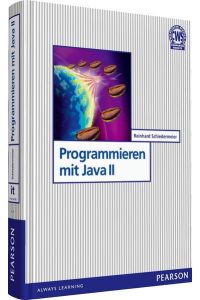
Programmieren mit Java II
von Reinhard Schiedermeier Verlag: Pearson Studium ein Imprint von Pearson Deutschla…
2013. Gepflegter, sauberer Zustand. Aus der Auflösung einer renommierten Bibliothek. Kann Stempel beinhalten. 23311083/202
- Sonderaktion: 10% Rabatt bis 05.11.2026

21,29 EUR
19,16 EUR

The Java Application Programming Interface II. Window Toolkit and Applets: 2 (Java Series) - James…
Verlag: Addison-Wesley Longman, Amsterdam
1996 Unbekannter Einband Gebrauchtes Exemplar in insgesamt gutem Erhaltungszustand mit Lesespuren und Knicke. Möglicherweise vorhandene Vorbesitzervermerke. Es können Abweichungen in Auflage, Schutzumschlag oder Coverabbildung zum Abbildungsexemplar vorliegen. Bitte rechnen Sie mit möglichen gew…
35,09 EUR

Computergeschichte(n) - nicht nur für Geeks: Von Antikythera zur Cloud mit DVD (Galileo Computing)…
von H. R. Wieland Verlag: Galileo Computing
2010 2010 Softcover 605 S. 23 x 17,6 x 3,4 cm Zustand: gebraucht - sehr gut, Geek, Nerd, Fan, Enthusiast, Insider oder einfach nur interessiert? Dieses Buch bietet Computergeschichte in vielen Geschichten: Es startet um ca. 30.000 v. Chr. und zeigt bis in die Zukunft, was es mit der revolutionäre…
44,99 EUR
![Springer Handbook of Robotics Incl DVD [Englisch] [Gebundene Ausgabe] Methods of Robotics Biologically-Inspired Robots Industrial Robotics Roboter Life-Like Robotics Manipulation and Interfaces of Robots Mobile and Distributed Robotics Roboethics Roboter Robotics Foundations Robot Structures Sensing and Perception of Robots Elektrotechnik Energietechnik ISBN-10 3-540-23957-X 354023957X ISBN-13 978-3-540-23957-4 9783540239574 Bruno Siciliano (Herausgeber), Oussama Khatib (Herausgeber) Robotik Robotertechnik Basic Principles and Methods of Robotics Biologically-Inspired Robots Industrial Robotics Life-Like Robotics Manipulation and Interfaces of Robots Mobile and Distributed Robotics Roboethics Roboter Robotics Foundations Robot Structures Sensing and Perception of Robots Elektrotechnik Energietechnik A new, authoritative and utterly comprehensive reference work on robotics that incorporates new developments, surpassing the narrow scope of other robotics handbooks that focus on industrial applications. Edited by internationally renowned experts. With the science of robotics undergoing a major transformation just now, Springer’s new, authoritative handbook on the subject couldn’t have come at a better time. Having broken free from its origins in industry, robotics has been rapidly expanding into the challenging terrain of unstructured environments. Unlike other handbooks that focus on industrial applications, the Springer Handbook of Robotics incorporates these new developments. Just like all Springer Handbooks, it is utterly comprehensive, edited by internationally renowned experts, and replete with contributions from leading researchers from around the world. The handbook is an ideal resource for robotics experts but also for people new to this expanding field. With the science of robotics undergoing a major transformation just now, Springer’s new, authoritative handbook on the subject couldn’t have come at a better time. Having broken free from its origins in industry, robotics has been rapidly expanding into the challenging terrain of unstructured environments. Unlike other handbooks that focus on industrial applications, the Springer Handbook of Robotics incorporates these new developments. Just like all Springer Handbooks, it is utterly comprehensive, edited by internationally renowned experts, and replete with contributions from leading researchers from around the world. The handbook is an ideal resource for robotics experts but also for people new to this expanding field. Bruno Siciliano is Professor of Control and Robotics at the University of Naples Federico II in Italy, President of the IEEE Robotics and Automation Society, and a Fellow of both IEEE and ASME. Oussama Khatib is Professor of Computer Science at Stanford University in the USA, President of the International Foundation of Robotics Research, an IEEE Fellow, and a recipient of the Japan Robot Association Award in Research and Development. Introduction (Bruno Siciliano, Oussama Khatib) Part A: Robotics Foundations (David Orin) Part A presents the fundamental principles and methods that are used to model, design, and control a robotic system. All of the foundational topics are included in this part: kinematics, dynamics, mechanical design and actuation, sensing and estimation, motion planning, motion control, force control, robotic systems architectures and programming, and AI reasoning methods for task planning and learning. A chapter is devoted to each of these topics. The topics are expanded and applied to specific robotic structures and systems in subsequent parts. Chap. 1. Kinematics (Ken Waldron, James Schmiedeler) Chap. 2. Dynamics (Roy Featherstone, David Orin) Chap. 3. Mechanisms and Actuation (Victor Scheinman, Michael McCarthy) Chap. 4. Sensing and Estimation (Henrik Christensen, Gregory Hager) Chap. 5. Motion Planning (Lydia Kavraki, Steve LaValle) Chap. 6. Motion Control (Wankyun Chung, Li-Chen Fu, Su-Hau Hsu) Chap. 7. Force Control (Luigi Villani, Joris De Schutter) Chap. 8. Robotic Systems Architectures and Programming (David Kortenkamp, Reid Simmons) Chap. 9. AI Reasoning Methods for Robotics (Joachim Hertzberg, Raja Chatila) Part B: Robot Structures (Frank Park) Part B is concerned with the design, modeling, motion planning, and control of the actual physical realizations of a robot. Some of the more obvious mechanical structures that come to mind are arms, legs, and hands; to this list can be added wheeled vehicles and platforms, and robot structures at the micro and nano scales. With separate chapters devoted to performance criteria and model identification, the chapters in this part successively examine serial redundant mechanisms, parallel mechanisms, flexible robots, robot hands, robot legs, wheeled robots, and micro- and nanoscale robots. Chap. 10. Performance Evaluation and Design Criteria (Jorge Angeles, Frank Park) Chap. 11. Redundant Manipulators (Stefano Chiaverini, Giuseppe Oriolo, Ian Walker) Chap. 12. Parallel Mechanisms and Robots (Jean-Pierre Merlet, Clément Gosselin) Chap. 13. Robots with Flexible Elements (Alessandro De Luca, Wayne Book) Chap. 14. Model Identification (John Hollerbach, Wisama Khalil, Maxime Gautier, ) Chap. 15. Robot Hands (Claudio Melchiorri, Makoto Kaneko) Chap. 16. Legged Robots (Shuuji Kajita, Bernard Espiau) Chap. 17. Wheeled Robots (Guy Campion, Woojin Chung) Chap. 18. Micro/Nano Robots (Brad Nelson, Lixin Dong, Fumihito Arai) Part C: Sensing and Perception (Henrik Christensen) Part C covers different sensory modalities and integration of sensor data across space and time to generate models of robots and the external environment. The main sensor types such as tactile, odometry, GPS, ranging and visual perception are presented. Both basic sensor models, sensor data processing and associated representations are covered. Finally, a chapter on sensor fusion itroduces the mathematical tools needed for integration of sensor information across space and time. Chap. 19. Force and Tactile Sensors (Mark Cutkosky, Robert Howe, William Provancher) Chap. 20. Inertial Sensors, GPS and Odometry (Gregory Dudek, Michael Jenkin) Chap. 21. Sonar Sensing (Lindsay Kleeman, Roman Kuc) Chap. 22. Range Sensors (Robert Fisher, Kurt Konolige) Chap. 23. 3D Vision and Recognition (Kostas Daniliidis, Jan-Olof Eklundh) Chap. 24. Visual Servoing and Visual Tracking (François Chaumette, Seth Hutchinson) Chap. 25. Sensor Fusion (Hugh Durrant-Whyte, Tom Henderson) Part D: Manipulation and Interfaces (Makoto Kaneko) Part D is separated into two subparts. The first half is concerned with manipulation where frameworks of modeling, motion planning, and control of grasp and manipulation of an object are addressed, and the second half is concerned with interfaces where physical human-robot interactions are handled. Chap. 26. Motion for Manipulation Tasks (Oliver Brock, James Kuffner, Jing Xiao) Chap. 27. Modelling and Manipulation (Imin Kao, Kevin Lynch, Joel Burdick) Chap. 28. Grasping (Jeff Trinkle, Domenico Prattichizzo) Chap. 29. Cooperative Manipulators (Fabrizio Caccavale, Masaru Uchiyama) Chap. 30. Haptics (Blake Hannaford, Allison Okamura) Chap. 31. Telerobotics (Günter Niemeyer, Carsten Preusche, Gerd Hirzinger) Chap. 32. Networked Teleoperation (Dezhen Song, Kenneth Goldberg, Nak Young Chong) Chap. 33. Exoskeletons for Human Performance Augmentation (Hami Kazerooni) Part E: Mobile and Distributed Robotics (Raja Chatila) Part E Mobile and Distributed Robotics, covers a wide span. The topics address motion planning and control of wheeled robots with kinematic constraints, perception and world modeling, simultaneous localization and mapping, and the integration of those capacities in a control architecture, as a mobile robot is actually the paradigm of a complex integrated system. In addition, multirobot interaction and systems are developed, including modular and reconfigurable robots as well as networked robotics. Chap. 34. Motion Control of Wheeled Mobile Robots (Pascal Morin, Claude Samson) Chap. 35. Motion Planning and Obstacle Avoidance (Javier Minguez, Florent Lamiraux, Jean-Paul Laumond) Chap. 36. World Modeling (Wolfram Burgard, Martial Hebert) Chap. 37. Simultaneous Localization and Mapping (Sebastian Thrun, John Leonard) Chap. 38. Behavior-Based Systems (Maja Mataric, François Michaud) Chap. 39. Distributed and Cellular Robots (Zack Butler, Alfred Rizzi) Chap. 40. Multiple Mobile Robot Systems (Lynne Parker) Chap. 41. Networked Robots (Vijay Kumar, Daniela Rus, Gaurav Sukhatme) Part F: Field and Service Robotics (Alexander Zelinsky) Part F covers topics related to creating field and service application based robots that operate in all types of environments. This includes applications ranging from industrial-robots, through a diverse array of air, land, sea and space applications to educational robotics. This part of the handbook draws on Parts A-E and describes how robots can be put to work. The chapters describe fit for purpose robots and include hardware design, control, perception, and user interfaces. The economic and social drivers for the particular applications are also discussed. Chap. 42. Industrial Robotics (Martin Hägele, Klas Nilsson, Norberto Pires) Chap. 43. Underwater Robotics (Gianluca Antonelli, Thor Inge Fossen, Dana Yoerger) Chap. 44. Aerial Robotics (Eric Feron, Eric Johnson) Chap. 45. Space Robots and Systems (Kazuya Yoshida, Brian Wilcox) Chap. 46. Robotics in Agriculture and Forestry (John Billingsley, Arto Visala, Mark Dunn) Chap. 47. Robotics in Construction (Kamel Saidi, Jonathan O’Brien, Alan Lytle) Chap. 48. Robotics in Hazardous Applications (James Trevelyan, Sungchul Kang, William Hamel) Chap. 49. Mining Robotics (Peter Corke, Jonathan Roberts, Jock Cunningham, David Hainsworth) Chap. 50. Search and Rescue Robotics (Robin Murphy, Satoshi Tadokoro, Daniele Nardi, Adam Jacoff, Paolo Fiorini, Howie Choset, Aydan Erkmen) Chap. 51. Intelligent Vehicles (Alberto Broggi, Alexander Zelinsky, Michel Parent, Charles Thorpe) Chap. 52. Medical Robots and Systems (Russell Taylor, Arianna Menciassi, Gabor Fichtinger, Paolo Dario) Chap. 53. Rehabilitation and Health Care Robotics (Machiel van der Loos, David J. Reinkensmeyer) Chap. 54. Domestic Robots (Erwin Prassler, Kazuhiro Kosuge) Chap. 55. Robots for Education (David Miller, Illah Nourbakhsh, Roland Siegwart) Part G: Human-Centered and Life-Like Robotics (Daniela Rus) Part G covers topics related to creating robots that operate in human-centered environments. This includes the design of robots with humanoid and other biologically inspired morphologies, sensors, actuators, and control architectures. User interfaces such as programming by demonstration and programming for safety are also included in this part. The part concludes with the socio-ethical implications of robots. Chap. 56. Humanoids (Charles Kemp, Paul Fitzpatrick, Hirohisa Hirukawa, Kazuhito Yokoi, Kensuke Harada, Yoshio Matsumoto) Chap. 57. Safety for Physical Human-Robot Interaction (Antonio Bicchi, Michael Peshkin, Edward Colgate) Chap. 58. Social Robots that Interact with People (Cynthia Breazeal, Atsuo Takanishi, Tetsunori Kobayashi) Chap. 59. Robot Programming by Demonstration (Aude Billard, Sylvain Calinon, Ruediger Dillmann, Stefan Schaal) Chap. 60. Biologically-Inspired Robots (Jean-Arcady Meyer, Agnès Guillot) Chap. 61. Evolutionary Robotics (Dario Floreano, Phil Husbands, Stefano Nolfi) Chap. 62. Neurorobotics: From Vision to Action (Michael Arbib, Giorgio Metta, Patrick van der Smagt) Chap. 63. Perceptual Robotics (Heinrich Bülthoff, Christian Wallraven, Martin Giese) Chap. 64. Roboethics: Social and Ethical Implications (Gianmarco Veruggio, Fiorella Operto) Elektrotechnik Energietechnik Basic Principles and Methods of Robotics Biologically-Inspired Robots Industrial Robotics Life-Like Robotics Manipulation and Interfaces of Robots Mobile and Distributed Robotics Roboethics Roboter Robotics Foundations Robot Structures Sensing and Perception of Robots Springer Handbook of Robotics ISBN-10 3-540-23957-X 354023957X ISBN-13 978-3-540-23957-4 9783540239574 Acknowledgements. - Subject Index. - About the Authors From the reviewsA comprehensive collection of the international accomplishments in the field and presents the very latest research in robotics. … Designed for research and practice, the handbook is edited by the internationally renowned robotics experts … . The coverage of all specialist fields infringing into robotics makes this handbook a reliable desk reference for scientists and engineers in the industry. It also provides basic and more advanced content for scholars from related disciplines such as biomechanics, neurosciences, virtual simulation, animation, surgery, and sensor networks, among others. (Renate Bayaz, EurekAlert!, May, 2008) Together with Oussama Khatib, who is a Professor of Computer Science at Stanford University, Siciliano has edited and launched a ‘Handbook of Robotics’ that aims to make the increasingly complex field of robotics more accessible to engineers, doctors, computer scientists and designers. … The handbook was conceived to provide a valuable resource not only for robotics experts, but also for newcomers to this expanding field [such as] engineers, medical doctors, computer scientists, and designers. (Liz Tay, iTnews, June, 2008) The ‘Springer Handbook of Robotics’ … basically differs from other handbooks of robotics focusing on industrial applications. It presents a widespread and well-structured coverage from the foundations of robotics, through the consolidated methodologies and technologies, up to the new emerging application areas of robotics. The handbook is an ideal resource for robotics experts but also for people new to this expanding field such as engineers, medical doctors, computer scientists, designers; edited by two internationally renowned experts. (Amazon, Juni, 2008) Siciliano and Khatib have assembled a massive and comprehensive tome on robotics, circa 2008. Sections of the book can be read by a diverse audience of undergraduate and graduate students, researchers and even the general public. Spanning any field associated with the subject. (W Boudville, Amazon, Juni, 2008) The handbook is a very large and truly encyclopedic work, covering all aspects of robotics, from fundamental principles to applications. The book’s 1, 600 pages are subdivided into seven parts … . Each of the seven parts is subdivided into multiple chapters, all written by experts in their fields throughout the world. … This amazing book does an incredible job of balancing theory and practice throughout. It should be an immensely valuable reference for students and practitioners of robotics for many years to come. (George A. Bekey, IEEE Robotics and Automation Magazine, September, 2008) The book’s seven parts and 64 chapters concisely review wholesomely ‘traditional’ applications of robotics, as well as address emerging questions of the science and technology of robots. … The volume is rich in indexes and lists. The accompanying DVD- ROM assists readers in perusing the topics. This is a must-have work for anyone with even a remote interest and interaction with this field. … Summing UpEssential. Graduate students, researchers, faculty, professionals, and informed general readers. (G. Trajkovski, Choice, Vol. 46 (6), February, 2009) SynopsisRobotics is undergoing a major transformation in scope and dimension. Starting from a predominantly industrial focus, robotics has been rapidly expanding into the challenges of unstructured environments. The Springer Handbookof Robotics incorporates these new developments and therefore basically differs from other handbooks of robotics focusing on industrial applications. It presents a widespread and well-structured conglomeration of new emerging application areas of robotics. The handbook is an ideal resource for robotics experts but also for people new to this expanding field such as engineers, medical doctors, computer scientists, designers; edited by two internationally renowned experts. Bruno Siciliano is Professor of Control and Robotics at University of Naples, President-Elect and Distinguished Lecturer of the IEEE Robotics and Automation Society, and he is on the board of the European Robotics Research Network. He is a Fellow of both IEEE and ASME. Oussama Khatib is Professor at Stanford University, President of IFRR, the International Foundation of Robotics Research, Distinguished Lecturer of the IEEE Robotics and Automation Society and a recipient of the JARA (Japan Robot Association) Award in Research and Development. He is a Fellow of the IEEE. Die Urgesteine der Robotik Bruno und Oussama haben sich mächtig ins Zeug gelegt, um die all die Korryphäen dieser Welt im Bereich Robotik zu einem gemeinsamen Standardwerk zusammen zu bringen. Hut ab - das ist ihnen gelungen. In dem Fach-Buch lässt sich viel über Robotertechnik lernen - und ist eine Abbildung des aktuellen Forschungs- und Wissenstands im Dunstkreis von Robotern. Das Buch ist ein wenig dick und schwer, so eignet es sich eher am Schreibtisch als im Freibad zu lesen - glücklicherweise gibt es zusätzlich die DVD, auf der das Buch in PDF drauf ist. So kann man hier Volltextsuche machen, und auf einem tragbaren Lesegerät (Laptop) das Ding doch ins Freibad mitnehmen;) Springer Handbook of Robotics Incl DVD [Englisch] [Gebundene Ausgabe] von Bruno Siciliano (Herausgeber), Oussama Khatib (Herausgeber)](/produkt-bild-vorschau/9783540239574/1/springer-handbook-of-robotics-incl-dvd-englisch-gebundene-ausgabe-methods-of-robotics-biologically-inspired-robots-industrial-robotics-roboter-life-like-robotics-manipulation-and-interfaces-of-robots-mobile-and-distributed-robotics-roboethics-rob.jpg) Beispielbild für diese ISBN
Beispielbild für diese ISBNSpringer Handbook of Robotics Incl DVD [Englisch] [Gebundene Ausgabe] Methods of Robotics Biologica…
von Bruno Siciliano Verlag: Springer
Auflage: 2008 (20. Mai 2008) Auflage: 2008 (20. Mai 2008) Hardcover 1611 S. 19,3 x 7,6 x 24,2 cm Zustand: gebraucht - sehr gut, A new, authoritative and utterly comprehensive reference work on robotics that incorporates new developments, surpassing the narrow scope of other robotics handbooks tha…
479,90 EUR
- Titel
- Programmieren mit Java II
Speichern Sie Ihre Suche als Auftrag für einen späteren Zeitpunkt und lassen Sie sich bei neu eintreffenden Artikeln automatisch per E-Mail benachrichtigen (optional)!