Ihr Marktplatz für antiquarische und neue Bücher | Login | Neu registrieren Registrieren
Buchfreund als App

Inheritance [Titel]

(1.944 Ergebnisse)
Titel
Inheritance
Titel: Inheritance
Applied Pattern Recognition: A Practical Introduction to Image and Speech Processing in C++ von Joachim Hornegger (Autor), Dietrich W. R. Paulus Algorithms and Implementation in C++ Design, structure and implementation of image and speech analysis systems - Digital filters, edge detection, image segmentation - Feature extraction from speech signals and classification - Fourier transform, image and speech compression - Introduction to C, C++ - Classes, inheritance and polymorphism Dietrich Paulus is a professor in computational visualistics at University Koblenz-Landau. Since over a decade he teaches image processing and programming languages. Joachim Hornegger is working for Siemens Medical Solutions, Inc. and the director of medical image processing. He is also a lecturer at the University of Mannheim teaching courses on medical image processing, discrete tomography, and 3D computer vision. From the contents: Design, structure and implementation of image and speech analysis systems - Digital filters, edge detection, image segmentation - Feature extraction from speech signals and classification - Fourier transform, image and speech compression - Introduction to C, C++ - Classes, inheritance and polymorphism Bildverarbeitung C++ Programmiersprache Efficient Algorithms Informatik EDV Image Processing Inheritance Mustererkennung Pattern Analysis pattern recognition Program Design programming regognition software development Speech processing Spracherkennung statistical pattern recognition ISBN-10 3-528-35558-1 3528355581 ISBN-13 978-3-528-35558-6 9783528355586 978-3528355586 Ein ganz großer Vorteil dieses Buches ist, dass die Thematik nicht nur auf einer abstrakten Ebene beschrieben wird, sondern dass im Buch immer wieder die Umsetzung der Aussagen in C++ gezeigt wird. neben einer Einführung in C++ werden die Algorithmen und Techniken immer wieder auch als Programm vorgestellt. Dadurch wird der Schritt von der Theorie - das heißt, dem als mathematische Formel beschriebenen Algorithmus - hin zur Praxis (dem Computerprogramm) durchgängig.  Elektronik This book demonstrates the efficiency of the C++ programming language in the realm of pattern recognition and pattern analysis. For this 3rd edition, new features of the C++ language were integrated and their relevance for image and speech processing is discussed. The description of the STL library was extended and STL is now used in many places in the book. The chapters 23 and 24 can now be used to build complete systems and give hints for further extensions. The book is divided into 4 parts. After an introduction to programming and software engineering, the required basics of image and speech processing are given. Statistics and mathematics is explained as required. The second part treats C++ as an object-oriented language and introduces it thru examples. In the third part the examples of the first and second part are combined to form an image segmentation and a word recognition system. All relevant features of the C++ language are thus introduced with direct relation to the tasks in image and speech processing. Die Behandlung der C++-Konstukte ist wirklich anwendungsnah.  Prof. Dr. Michael Schenke, FH Merseburg // sehr umfassend - anschaulich, klar, gut nachvollziehbar.  Prof. Dr. -Ing. Hans Peter Kölzer, HAW Hamburg Dieses Buch werde ich meinen Studenten empfehlen, weil es einen sehr anschaulichen und motivierenden Einstieg in die Mustererkennung bietet.  Prof. Dr. Hans-Peter Weber, FH Darmstadt Concerning 3rd edition: This book is a beautifully arranged marriage of state-of-the-art pattern recognition theory and of programming theory and practice. The elegant and thorough treatment of modern aspects of speech and video processing and interpretation springs to life through a multitude of well-designed case studies and concrete examples.  Carlo Tomasi, Prof. of Computer Science, Duke University, USA This book is a must for learners of practical image processing. The examples are well explained and cover the needs of a graduate image processing or pattern recognition course.  Laszlo Csink, Prof. of Computer Science, Budapest Polytechnic John von Neumann Faculty of Informatics, Hungary I am not aware of a book comparable to this one which gives an excellent combination of an account of relevant topics in pattern recognition as well as of techniques for implementing the equations and algorithms in C++. Therefore, the book is invaluable both to students starting in the field and and to practitioners needing a special algorithm and its implementation.  H. Niemann, Prof. of Computer Science, Friedrich-Alexander Universität Erlangen-Nürnberg, Germany // this book has been the perfect source for my students and me. Not only that the reader is elegantly and in a straightforward manner guided to the central points of the theory, but in parallel the authors also make it transparent how to implement the algorithms resulting from the theory.  Volkmar Welker, Prof. of Discrete Mathematics, University of Marburg, Germany Bildverarbeitung C++ Programmiersprache Efficient Algorithms Informatik EDV Image Processing Inheritance Mustererkennung Pattern Analysis pattern recognition Program Design programming software development Speech processing Spracherkennung statistical pattern recognition Applied Pattern Recognition A Practical Introduction to Image and Speech Processing in C++

Applied Pattern Recognition: A Practical Introduction to Image and Speech Processing in C++ von Joa…

4,00 Ødurchschnittliche Bewertung · 1 Bewertungen bei Goodreads

von Joachim Hornegger Dietrich W. R. Paulus Verlag: Vieweg+Teubner Verlag

4. Auflage 4th edition 4. Auflage 4th edition Softcover 372 S. 23,9 x 16,3 x 2 cm Zustand: gebraucht - sehr gut, Design, structure and implementation of image and speech analysis systems - Digital filters, edge detection, image segmentation - Feature extraction from speech signals and classificat…

Bestell-Nr.: BN25408
ISBN: 3528355581
Anbieter: BUCHSERVICE / ANTIQUARIAT Lars-Lutzer *** LITERA…, Wahlstedt, Deutschland

Verkäufer akzeptiert PayPal

199,90 EUR

zzgl. 6,99 EUR Verpackung & Versand
The Red Sea from Byzantium to the Caliphate: AD 500-1000 Timothy Power Byzanz Islam This book examines the historic process traditionally referred to as the fall of Rome and rise of Islam from the perspective of the Red Sea, a strategic waterway linking the Mediterranean to the Indian Ocean and a distinct region incorporating Africa with Arabia. The transition from Byzantium to the Caliphate is contextualized in the contestation of regional hegemony between Aksumite Ethiopia, Sasanian Iran, and the Islamic Hijaz. The economic stimulus associated with Arab colonization is then considered, including the foundation of ports and roads linking new metropolises and facilitating commercial expansion, particularly gold mining and the slave trade. Finally, the economic inheritance of the Fatimids and the formation of the commercial networks glimpsed in the Cairo Geniza is contextualized in the diffusion of the Abbasid ‘bourgeois revolution’ and resumption of the ‘India trade’ under the Tulunids and Ziyadids. Timothy Power’s careful analysis reveals the complex cultural and economic factors that provided a fertile ground for the origins of the Islamic civilization to take root in the Red Sea region, offering a new perspective on a vital period of history. The Red Sea from Byzantium to the Caliphate AD 500-1000

The Red Sea from Byzantium to the Caliphate: AD 500-1000 Timothy Power Byzanz Islam This book exami…

von Timothy Power Verlag: The American University in Cairo Press

2012 2012 Hardcover 379 S. Zustand: gebraucht - sehr gut, This book examines the historic process traditionally referred to as the fall of Rome and rise of Islam from the perspective of the Red Sea, a strategic waterway linking the Mediterranean to the Indian Ocean and a distinct region incorpora…

Gebraucht, sehr gut
Bestell-Nr.: BN335273
ISBN: 9774165446
Anbieter: BUCHSERVICE / ANTIQUARIAT Lars-Lutzer *** LITERA…, Wahlstedt, Deutschland

Verkäufer akzeptiert PayPal

699,90 EUR

zzgl. 9,99 EUR Verpackung & Versand
C++ Primer. (Broschiert) von Stanley B. Lippman (Autor), Josée Lajoie (Autor), Barbara E. Moo Dieses Buch bietet eine umfassende Einführung in die Programmiersprache C++. Es ist ein Grundlehrbuch mit einem klaren, praxisorientierten Ansatz, der durch zahlreiche Beispiele und andere Lernhilfen unterstützt wird. Anders als andere einführende Bücher enthält dieses auch eine ausführliche Beschreibung der Sprache mit besonderem Augenmerk auf aktuelle und wirkungsvolle Programmiertechniken. Diese vollständig aktualisierte Ausgabe hebt den modernen Stil der C++-Programmierung hervor. Denn mittlerweile steht die Standardbibliothek im Mittelpunkt, während die Techniken für die Low-Level-Programmierung mit der Zeit an Gewicht verloren haben. Grundlagen und Bibliothek werden so gemeinsam vorgestellt. Dadurch können Sie schnell sinnvolle Programme schreiben. Erst nachdem diese feste Grundlage zur Nutzung der Bibliothek und zum Schreiben der Art von abstrakten Programmen gelegt wurde, die die Bibliothek ermöglicht, lernen Sie die Merkmale von C++ kennen, mit deren Hilfe Sie Ihre eigenen Abstraktionen schreiben können. Teil I und II behandeln die Grundlagen der Sprache und die Bibliothek. Der Schwerpunkt dieser Teile liegt darauf, Ihnen beizubringen, wie Sie C++-Programme schreiben und Abstraktionen der Bibliothek einsetzen. In Teil III bis V geht es darum, wie Sie Typen schreiben. Teil III führt Sie in das Herzstück von C++ ein: die Unterstützung der Klassen. Der Klassenmechanismus ist die Grundlage, um eigene Abstraktionen zu schreiben, und das Fundament für objektorientierte und generische Programmierung, die wir in Teil IV behandeln. Diese Buch schließt mit Teil V über erweiterte Merkmale ab, die hauptsächlich dazu eingesetzt werden, große, komplexe System zu gliedern. Über den Autor: Stanley B. Lippman arbeitet in den ATundT Bell Laboratories, wo er an der Implementierung verschiedener Versionen des ATundT C Plusplus Compilers mitgearbeitet hat. Er hat C Plusplus in vielen Kursen für Anfänger und erfahrene Programmierer unterrichtet. Inhaltsverzeichnis von C++ Primer (der US-Originalausgabe): Preface xix Chapter 1. Getting Started 1 1. 1 Writing a Simple C++ Program 21. 2 A First Look at Input/Output 5 1. 3 A Word About Comments 101. 4 Control Structures 11 1. 5 Introducing Classes 201. 6 The C++ Program 25 Chapter Summary 28Defined Terms 28 Part I. The Basics 31 Chapter 2. Variables and Basic Types 33 2. 1 Primitive Built-in Types 342. 2 Literal Constants 37 2. 3 Variables 432. 4 const Qualifier 56 2. 5 References 582. 6 Typedef Names 61 2. 7 Enumerations 622. 8 Class Types 63 2. 9 Writing Our Own Header Files 67Chapter Summary 73 Defined Terms 73 Chapter 3. Library Types 77 3. 1 Namespace using Declarations 783. 2 Library string Type 80 3. 3 Library vector Type 903. 4 Introducing Iterators 95 3. 4. 1 Iterator Arithmetic 1003. 5 Library bitset Type 101 Chapter Summary 107Defined Terms 107 Chapter 4. Arrays and Pointers 109 4. 1 Arrays 1104. 2 Introducing Pointers 114 4. 3 C-Style Character Strings 1304. 4 Multidimensioned Arrays 141 Chapter Summary 145Defined Terms 145 Chapter 5. Expressions 147 5. 1 Arithmetic Operators 1495. 2 Relational and Logical Operators 152 5. 3 The Bitwise Operators 1545. 4 Assignment Operators 159 5. 5 Increment and Decrement Operators 1625. 6 The Arrow Operator 164 5. 7 The Conditional Operator 1655. 8 The size of Operator 167 5. 9 Comma Operator 1685. 10 Evaluating Compound Expressions 168 5. 11 The new and delete Expressions 1745. 12 Type Conversions 178 Chapter Summary 188Defined Terms 188 Chapter 6. Statements 191 6. 1 Simple Statements 1926. 2 Declaration Statements 193 6. 3 Compound Statements (Blocks) 1936. 4 Statement Scope 194 6. 5 The if Statement 1956. 5. 1 The if Statement else Branch 197 6. 6 The switch Statement 1996. 7 The whileStatement 2046. 8 The for Loop Statement 2076. 9 The do while Statement 210 6. 10 The break Statement 2126. 11 The continue Statement 214 6. 12 The goto Statement 2146. 13 try Blocks and Exception Handling 215 6. 13. 1 A throw Expression 2166. 13. 2 The try Block 217 6. 13. 3 Standard Exceptions 2196. 14 Using the Preprocessor for Debugging 220 Chapter Summary 223Defined Terms 223 Chapter 7. Functions 225 7. 1 Defining a Function 2267. 2 Argument Passing 229 7. 3 The return Statement 2457. 4 Function Declarations 251 7. 5 Local Objects 2547. 6 Inline Functions 256 7. 7 ClassMemberFunctions 2587. 8 Overloaded Functions 265 7. 9 Pointers to Functions 276Chapter Summary 280 Defined Terms 280 Chapter 8. The IO Library 283 8. 1 An Object-Oriented Library 2848. 2 Condition States 287 8. 3 Managing the Output Buffer 2908. 4 File Input and Output 293 8. 5 String Streams 299Chapter Summary 302 Defined Terms 302 Part II. Containers and Algorithms 303 Chapter 9. Sequential Containers 305 9. 1 Defining a Sequential Container 3079. 2 Iterators andIteratorRanges 311 9. 3 Sequence Container Operations 3169. 4 How a vector Grows 330 9. 5 Deciding Which Container to Use 3339. 6 strings Revisited 335 9. 7 Container Adaptors 348Chapter Summary 353 Defined Terms 353 Chapter 10. Associative Containers 355 10. 1 Preliminaries: the pair Type 35610. 2 Associative Containers 358 10. 3 The map Type 36010. 4 The set Type 372 10. 5 The multimap and multiset Types 37510. 6 Using Containers: Text-Query Program 379 Chapter Summary 388Defined Terms 388 Chapter 11. Generic Algorithms 391 11. 1 Overview 39211. 2 A First Look at the Algorithms 395 11. 3 Revisiting Iterators 40511. 4 Structure of Generic Algorithms 419 11. 5 Container-Specific Algorithms 421Chapter Summary 424Defined Terms 424 Part III. Classes and Data Abstraction 427 Chapter 12. Classes 429 12. 1 Class Definitions and Declarations 43012. 2 The Implicit this Pointer 440 12. 3 Class Scope 44412. 4 Constructors 451 12. 5 Friends 46512. 6 static Class Members 467 Chapter Summary 473Defined Terms 473 Chapter 13 Copy Control 475 13. 1 The Copy Constructor 47613. 2 The Assignment Operator 482 13. 3 The Destructor 48413. 4 A Message-Handling Example 486 13. 5 Managing Pointer Members 492Chapter Summary 502 Defined Terms 502 Chapter 14. Overloaded Operations and Conversions 505 14. 1 Defining an Overloaded Operator 50614. 2 Input andOutputOperators 513 14. 3 Arithmetic and Relational Operators 51714. 4 Assignment Operators 520 14. 5 Subscript Operator 52214. 6 Member Access Operators 523 14. 7 Increment and Decrement Operators 52614. 8 Call Operator and Function Objects 530 14. 9 Conversions and Class Types 535Chapter Summary . 552 Defined Terms 552 Part IV. Object-Oriented and Generic Programming 555 Chapter 15. Object-Oriented Programming 557 15. 1 OOP: An Overview 55815. 2 Defining Base and Derived Classes 560 15. 3 Conversions and Inheritance 57715. 4 Constructors and Copy Control 580 15. 5 Class Scope under Inheritance 59015. 6 Pure Virtual Functions 595 15. 7 Containers and Inheritance 59715. 8 Handle Classes and Inheritance 598 15. 9 Text Queries Revisited 607Chapter Summary 621 Defined Terms 621 Chapter 16. Templates and Generic Programming 623 16. 1 Template Definitions 62416. 2 Instantiation 636 16. 3 Template Compilation Models 64316. 4 Class Template Members 647 16. 5 A Generic Handle Class 66616. 6 Template Specializations 671 16. 7 Overloading and Function Templates 679Chapter Summary 683Defined Terms 683 Part V. Advanced Topics 685 Chapter 17. Tools for Large Programs 687 17. 1 Exception Handling 68817. 2 Namespaces 712 17. 3 Multiple and Virtual Inheritance 731Chapter Summary 748 Defined Terms 748 Chapter 18. Specialized Tools and Techniques 753 18. 1 Optimizing Memory Allocation 75418. 2 Run-Time Type Identification 77218. 3 Pointer to Class Member 78018. 4 Nested Classes 786 18. 5 Union: A Space-Saving Class 79218. 6 Local Classes 796 18. 7 Inherently Nonportable Features 797Chapter Summary 805 Defined Terms 805 Appendix A. The Library 809 A. 1 Library Names and Headers 810A. 2 A Brief Tour of the Algorithms 811 A. 3 The IO Library Revisited 825 Index 843 Mit der neuen Auflage des C++ Primer wurde eines der besten Bücher für den Einstieg in C++ um den aktuellen Stand von C++ verbessert und erweitert. Im Zentrum stehen die integrierten Spracheigenschaften des C++-Standards. Für die neue Auflage, die in einer gewichtigen 1. 237-Seitenausgabe auf den Tisch kommt, hat sich der bekannte C++-Experte Stanley Lippman mit Josée Lajoie zusammengetan. Lajoie hat mitgeholfen, den internationalen Sprachstandard für C++ zu definieren. Der neue Stoff eignet sich vor allem für Programmierer, die möglichst viel aus den neuen und weiterentwickelten Möglichkeiten der Sprache herausholen wollen. Zwar führen die Autoren noch immer in die Grundlagen von C++ wie Datentypen und Zeiger ein, ihr Augenmerk richtet sich jedoch schnell darauf, die Möglichkeiten des neuen ISO-C++-Standards auszureizen. Wie ein roter Faden zieht sich ein durchdachter und getesteter Sprachgrundlagenkurs durch das Buch, der die Unterstützung für die Standard-C++-Bibliothek mit Kontainerklassen wie Vektoren und Maps sowie weitere Standardoptionen abdeckt. Die wichtigen neuen Optionen von C++ wie Vorlagen, Namensräume und Echtzeit-Typenidentifikation werden umfangreich abgedeckt. Das Ergebnis ist ein klarer, lesbarer und verlässlicher Führer durch den grundlegenden und fortgeschrittenen C++-Jungel mit vielen kurzen und praktischen Beispielen, die sich durch den Text ziehen. Für jeden Abschnitt stehen manchmal recht herausfordernde Übungen zur Verfügung, die das Buch insgesamt zur ersten Wahl für das Selbststudium und das Klassenzimmer machen. Schneller und effizienter programmieren mit dem C++-Primer - dem vollständig aktualisierten Klassiker. Damit lernen Sie die Sprache noch schneller und sie auf moderne Weise einzusetzen. Sämtliche Aspekte werden ausführlich behandelt. Die Autoren geben zunächst einen Überblick über Grundlagen von C++ wie beispielsweise Datentypen, Konstanten und Variablen, die Verwendung von Funktionen und Klassen sowie den Umgang mit Zeigern und Vektoren. Anhand guter Programmierpraxis zeigen sie, wie Programme entwickelt werden, die sicher sind, schnell erstellt werden können und zugleich die bestmögliche Leistung erzielen. Weiterführende Aspekte von C++ wie Exception Handling, Containertypen, objektorientierte Programmierung, Typumwandlungen u. a. werden im Kontext von konkreten Problemlösungen und Programmieraufgaben erläutert. Wie in den vorhergehenden Ausgaben auch sorgt die kompetente Erläuterung der grundlegenden Konzepte von C++ dafür, dass dieses Buch auch für erfahrene Programmierer ein wertvolles Hilfsmittel und eine wichtige Referenz darstellt. Eins der besten und umfassensten C++-Lehrbücher! An modernen, zeitgemäßen Programmierstil angepasst, werden hier Grundlagen und Standardbibliothek anhand verständlicher Beispiele konsequent von Anfang an zusammen vermittelt. Was durchaus sinnvoll ist. So lernt man schnell die Möglichkeiten abzuschätzen, die die abstrakte Programmierung wirklich zu bieten hat. Ansätze bisheriger Lehrbücher erst Funktionen und Merkmale ausführlich abzuhandeln bevor auch nur ein Wort über die Bibliothek und den Einsatz von Abstraktionen fällt sind frustrierend. Der C++-Primer neueste Lehrmethoden, gute Beispiele, umfassend - ist derzeit schlicht und einfach DIE praxisnahe Einführung ins C++-Universum und hat fünf Sterne verdient.

C++ Primer. (Broschiert) von Stanley B. Lippman (Autor), Josée Lajoie (Autor), Barbara E. Moo Diese…

4,22 Ødurchschnittliche Bewertung · 997 Bewertungen bei Goodreads

von Stanley B. Lippman Josée Lajoie Barbara E. Moo Verlag: Addison Wesley Imprint in der Pearson Education D…

Auflage: 4., völlig überarb. A. (2006 Auflage: 4., völlig überarb. A. (2006 Softcover 1006 S. 23,8 x 16,8 x 5,6 cm Zustand: gebraucht - sehr gut, Dieses Buch bietet eine umfassende Einführung in die Programmiersprache C++. Es ist ein Grundlehrbuch mit einem klaren, praxisorientierten Ansatz, der…

Bestell-Nr.: BN2316
ISBN: 382732274X
Anbieter: BUCHSERVICE / ANTIQUARIAT Lars-Lutzer *** LITERA…, Wahlstedt, Deutschland

Verkäufer akzeptiert PayPal

55,90 EUR

zzgl. 6,99 EUR Verpackung & Versand
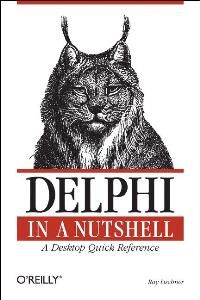
Delphi in a Nutshell. A Desktop Quick Reference. : A Desktop Quick Reference (In a Nutshell (O`Reilly)) von Ray Lischner Delphi is quite rightly reckoned to be one of the best IDEs (Integrated Development Environments), and ideal for rapid program development thanks to its use of VCL. The Nutshell series are information-dense reference titles, and Delphi In A Nutshell doesn`t disappoint. After a fast tour of Delphi`s version of the Pascal language and the files and forms used in the Delphi IDE you get an overview of object oriented programming as it relates to Delphi. There`s coverage of of Delphi usage including scheduling, thread synchronisation and so on, then it`s on to the language itself. Each language element is named, its syntax and a description with any gotchas noted. There`s a tips and tricks section followed by example usage and pointers to related material. This is a lot to pack in for every Delphi language element. One consequence is the need to limit the examples, which is a pity as they`re often the most useful information. At the end of the book the last chapter deals with compiler directives and two appendices cover Delphi`s command line tools and the separate but indispensable SysUtils unit. Delphi In A Nutshell isn`t the kind of book you read in the bath, but it is one every Delphi programmer should have available when out of it. Aimed at the working Delphi developer, Delphi in a Nutshell is an effective desktop reference to this popular programming tool. Besides listing all core classes and methods, this book also provides a host of expert dos and don`ts for mastering the newest features in Delphi`s Object Pascal. The heart of this book is its reference sections on built-in Delphi language features and other useful information on this development tool. Each entry has a guide to syntax, a description of all parameters and return values, and code samples, plus many entries feature tricks and tips with additional information. While this title concentrates on the core language (instead of Delphi`s extensive support for visual components), there`s little doubt that it will be useful if you work with the tool on a daily basis. The book also delivers an advanced guide to ramping up on the latest and greatest in new language features in Object Pascal. Material on using classes, and the type of information features available in today`s Delphi, are particularly effective. There are a lot of smart tips on proper class design techniques, including using properties, constructors, and destructors. (Delphi has its own conventions here, and this book will fill you in if you are coming to Object Pascal from another programming language. ) Along the way, the author offers numerous expert nuggets on when to use (and when to avoid) using certain features. Whether you are a novice or a more experienced developer, this tutorial and reference is all you need to be productive with the latest and greatest in object-oriented programming with Delphi. Topics coveredOverview of Delphi Object Pascal, units and libraries, data and string types, exception handling, file I/O, classes and objects, inheritance, constructors and destructors, interfaces, reference counting, Windows messages, memory management strategies, virtual method tables (VMTs), properties, using TypInfo, virtual and dynamic methods, automated methods and COM, Delphi type information and RTTI, concurrent programming with threads, synchronization, thread local storage techniques, Delphi language reference, system constants, operator reference, compiler directives, code samples, and programming tips.

Delphi in a Nutshell. A Desktop Quick Reference. : A Desktop Quick Reference (In a Nutshell (O`Reil…

4,17 Ødurchschnittliche Bewertung · 24 Bewertungen bei Goodreads

von Ray Lischner Verlag: OREILLY & ASSOC INC O`Reilly Media

2000 2000 Softcover 576 S. 22,7 x 15,1 x 3,2 cm Zustand: gebraucht - sehr gut, IDEs VCL Integrated Development Environments synchronisation programmer SysUtils programming tool Object Pascal I/O Windows messages VMTs virtual method tables TypInfo dy Delphi is quite rightly reckoned to be one of t…

Bestell-Nr.: BN0906
ISBN: 1565926595
Anbieter: BUCHSERVICE / ANTIQUARIAT Lars-Lutzer *** LITERA…, Wahlstedt, Deutschland

Verkäufer akzeptiert PayPal

3,89 EUR

zzgl. 6,99 EUR Verpackung & Versand